
Amur Tiger vs Bengal Tiger: Who Is the Victor?
Introduction
Put a Bengal tiger next to an Amur tiger and the first thing you will notice is the difference in size. But weight isn't the only thing that will determine the outcome of a fight. Winter temperatures regularly dip below -20°F, so both species have evolved certain adaptations. One is designed for tropical heat and close-quarter ambush in the jungle, the other for deep snow and long-range stalking. This comparison is how the two largest populations of tigers on Earth actually stack up and what would happen if their paths ever crossed.
Bengal Tiger vs. Amur Tiger: Quick Comparison Chart
| Trait | Bengal Tiger | Amur (Siberian) Tiger |
|---|---|---|
| Scientific classification | Panthera tigris tigris | Panthera tigris altaica |
| Male weight | 400-570 lbs (180-260 kg) | 400-660 lbs (180-300 kg) rare outliers up to 800+ lbs |
| Male length (nose to tail) | Up to 10 ft (3 m) | 10.5–12 ft (3.2–3.7 m) |
| Coat | Heavy black striping, deep orange | Less, thinner stripes, rusty pale orange |
| Fur | Short, thin | Long, thick winter ruff |
| Range | India, Nepal, Bhutan, Bangladesh | Russian Far East, small pockets in NE China |
| Wild population (2024) | ~3,700-4,500 | ~500-600 |
| Status | Endangered | Endangered |
Size and Weight: Who's Really Bigger?

The Amur tiger wins this one, but not by as much as most people would think. Adult male Amur tigers are, on average, heavier and longer than adult male Bengals. A wild Amur male will typically weigh about 660 pounds and measure 10.5 feet, while a Bengal male usually maxes out around 570 pounds and 10 feet. That size gap is a matter of Bergmann's rule. Animals that live in colder climates tend to evolve larger bodies, because a larger mass retains heat more efficiently relative to its surface area.
That said, the record books for the "world's biggest tiger" become murky quickly. Captive Amur tigers have recorded weights well over 800 pounds, and there are unverified hunting reports from the 20th century of Manchurian males approaching 900. But in the wild, both subspecies rarely achieve those numbers – food scarcity, territory size and constant physical activity keep wild tigers leaner than their captive counterparts.
Coat and Colour: How to Tell Them Apart
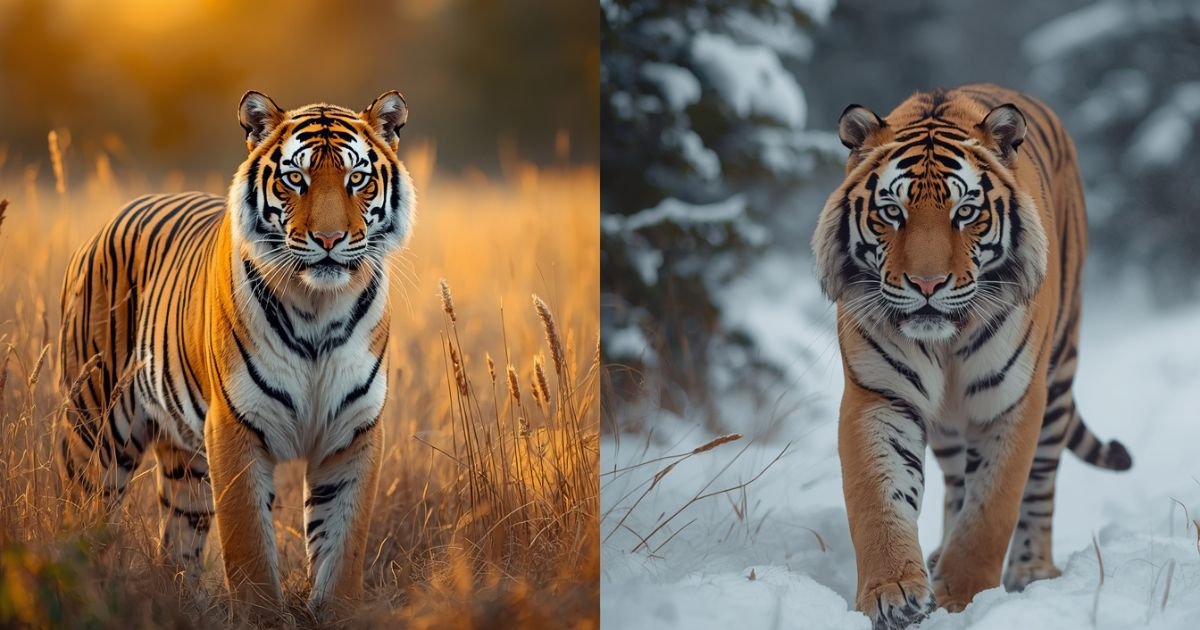
The coat is the quickest way to tell them apart if you are looking at photos rather than a spec sheet. Bengal tigers are bright orange with bold, close-set black stripes – the classic "tiger" image most people picture. Amur tigers are paler and rustier, almost brownish-orange in winter, with much thinner and more widely spaced stripes.
A bigger giveaway is fur density. Amur tigers develop a thick winter coat with a ruff around their neck and face that resembles a mane and a layer of body fat that can add more than an inch of insulation. Bengal tigers do not need to develop a thick winter coat because their range rarely drops below freezing, allowing their coat to remain close to the body, regardless of size or length.
Habitat: Indian Heat and Siberian Cold
About as different environments as a big cat could live in, these two subspecies inhabit. Bengal tigers live in the mangrove swamps, grasslands, and dry deciduous forests of India—and smaller, isolated populations survive in Nepal, Bhutan, and Bangladesh. India's Sundarbans mangrove forest, for example, is one of the only tiger populations known to regularly hunt in tidal water.
The Amur tigers lead an almost opposite life. Their stronghold is the Sikhote-Alin mountain range in Russia's Primorsky Krai, where winter temperatures regularly dip below -20°F (-29°C). Prey is so much rarer in a boreal forest than in an Indian floodplain that the range of free-roaming Amur tigers can cover more than 400 square miles—several times the size of a typical Bengal's range.
Diet and Style of Hunting
Both subspecies are ambush predators that rely on stealth rather than speed, but their menus vary by habitat. Bengal tigers hunt chital deer, sambar, wild boar and sometimes young gaur or water buffalo, prey that is sometimes so abundant that a healthy Bengal can make a kill every five to six days.
Amur tigers have a harder job. Their main prey—red deer and wild boar—are patchily distributed across a vast cold terrain, so an Amur tiger might cover 10 or more miles in a single night's hunting and go more than a week between kills. That scarcity is also why Amur territories are so huge: a tigress needs enough square miles to ensure she comes across prey often enough to feed cubs.
Bite Force and Strength
Here, the size advantage translates fairly directly into brute force. The larger size generally means a larger skull and stronger bite. This means Amur tigers tend to win out over Bengals in raw bite force and the ability to drag down heavier prey—Amur tigers have been known to kill brown bears, something Bengal tigers rarely encounter as prey. However, the bite force of both subspecies is the same as the tiger standard, estimated at 1,000 psi, among the strongest of any land predator, and easily capable of crushing bone.
The Bengals might have an advantage in quickness. The reward on the long, open country stalks an Amur tiger relies on in the taiga is quick, tight-turning ambush attacks when the terrain is dense jungle and mangrove.
Bengal Tiger vs Amur Tiger: Who Would Win In A Fight

This is a hypothetical, as their ranges never overlap in the wild, but this is the question most people searching this comparison actually want answered. The Amur tiger has the edge in pure physical measurements: it is heavier on average, has a longer reach, and bites a little harder. In a straight strength contest, size usually wins in the cat family, and that favors the Amur.
However, a real encounter isn't determined by a spec sheet. Individual health, age, and experience are more important than subspecies average. A big, fat male Bengal at the top of his weight range (570+ lbs) could take on many Amur tigers, especially since wild Amurs with leaner prey don't always reach their theoretical size maximum. My honest take is that, based on raw average statistics, one should bet on the Amur tiger; however, since tiger fights are close enough and rare enough, saying 'it depends on the individual' is not a cop-out in this context. That is the right answer.
Conservation Status: Both Endangered But Different Pressures

Neither subspecies is safe, but their threats appear to be different. Bengal tigers do have the bigger numbers problem in absolute terms—poaching for the illegal wildlife trade and habitat fragmentation due to India's expanding agriculture and road networks are the main pressures, even though India's 3,600+ felines make Bengal the most numerous tiger population on the planet.
Amur tigers are in a population crisis. The subspecies is more vulnerable to a single disastrous event—disease outbreak, extreme poaching surge, or habitat loss—wiping out a significant proportion of the total population overnight, leaving approximately 500-600 individuals mainly concentrated in one region of Russia. Conservation efforts on both sides focus on anti-poaching patrols, protected corridors, and reducing human-tiger conflict as farming and development encroach on remaining habitat.
Learn more about tiger conservation and how you can help protect these magnificent animals.
🐆 Related Big Cat Guides
Explore more big cat species and comparisons.
Frequently Asked Questions
The Bottom Line
The Amur tiger wins on brute size, strength, and cold-weather survival skills. Across a tougher, more fragmented human landscape, the Bengal tiger wins on numbers, jungle agility, and sheer resilience. Neither title means much compared to the fact that both subspecies are endangered—and both need the same things to survive long-term: protected territory, intact prey populations, and fewer conflicts with the people who now live within their range.
Discover More Animals
Explore thousands of animal species with our free online random animal generator tool.
RANDOM ANIMAL GENERATOR