
African vs Asian Elephant: 7 Key Differences
Introduction
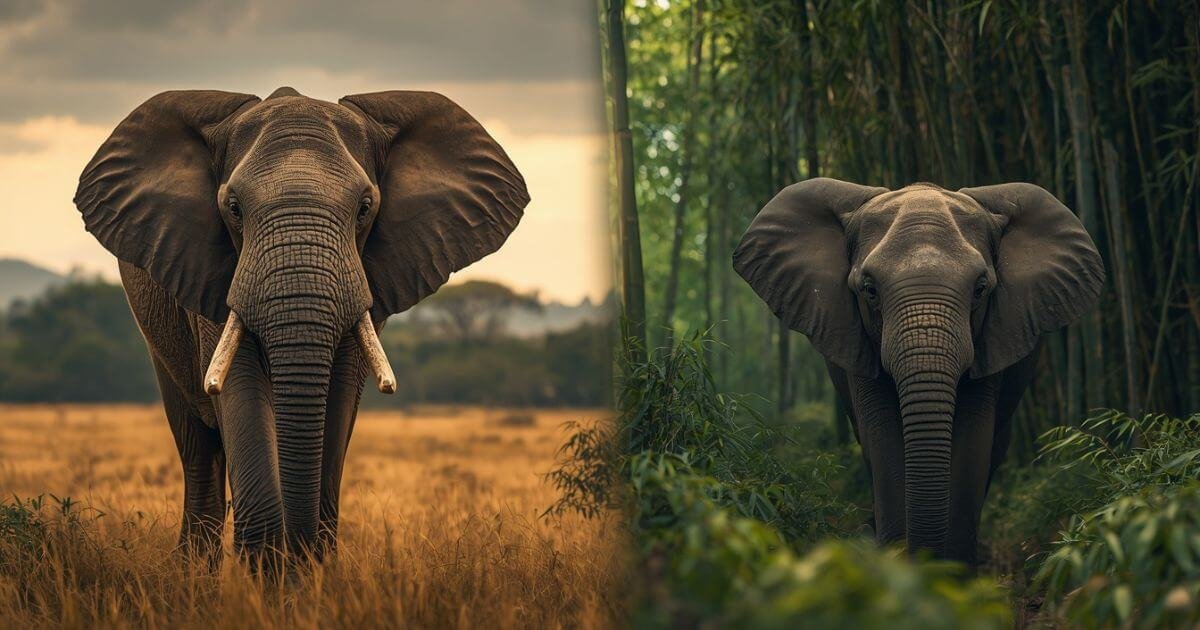
The African elephant is larger, with massive ears shaped like the continent of Africa. Both males and females grow long tusks. The Asian elephant is smaller, with rounded ears. Usually only males have visible tusks.
That is the quick answer. But the real differences go much deeper – from the tip of their trunks to the shape of their backs.
Whether you are a traveler planning a safari, a student writing a report, or a business professional booking a corporate zoo event, knowing how to tell these two magnificent species apart is essential.
Quick Comparison Chart
| Feature | African Elephant | Asian Elephant |
|---|---|---|
| Scientific name | Loxodonta africana | Elephas maximus |
| Male height | 10–13 ft | 8–10 ft |
| Male weight | 8,000–14,000 lbs | 6,000–11,000 lbs |
| Ear shape | Africa-shaped | Rounded |
| Ear size | Up to 6 ft wide | 2–3 ft wide |
| Tusks (males) | Yes | Yes |
| Tusks (females) | Yes | No (small "tushes") |
| Trunk tip fingers | 2 | 1 |
| Forehead shape | Sloping, single dome | Twin-dome |
| Back shape | Concave (dips) | Convex (rounded) |
| Skin texture | More wrinkled | Smoother |
| Toenails | 4 front, 3 back | 5 front, 4 back |
| Wild population | ~350,000 (savanna) + ~100,000 (forest) | ~40,000–50,000 |
| IUCN status | Endangered | Endangered |

Size: Which Elephant Is Bigger?
The African elephant is the largest land animal on Earth.
An adult male African elephant stands 10–13 feet tall at the shoulder and weighs 8,000–14,000 pounds. The largest recorded individual weighed about 24,000 pounds.
An adult male Asian elephant stands 8–10 feet tall and weighs 6,000–11,000 pounds.
Why size matters for businesses: Larger animals require more habitat, more food, and more space in zoo exhibits. African elephant exhibits in AZA-accredited zoos need significantly more acreage than Asian elephant exhibits.
Voice search answer: "The African elephant is larger, weighing up to 14,000 pounds compared to the Asian elephant's 11,000 pounds."
Ears: The Africa vs Asia Clue
This is the single easiest way to tell them apart – even from a distance.
African elephants have enormous ears shaped roughly like the continent of Africa. Each ear can reach 6 feet wide and weigh over 100 pounds. They flap their ears to cool their blood – a critical adaptation for the hot savanna.
Asian elephants have smaller, rounded ears that look more like the shape of India. Their ears are about 2–3 feet wide.
Why the difference matters: Africa is hotter than most of Asia. Larger ears give African elephants a better cooling system. For zoo exhibit designers, this means African elephants need access to shade and water for cooling, while Asian elephants are slightly more tolerant of temperature variations.

Tusks: Who Has Them and Who Doesn't?
African elephants: Both males AND females grow tusks. Tusks are elongated incisor teeth used for digging, stripping bark, fighting, and lifting. The longest recorded African tusk was over 11 feet long.
Asian elephants: Usually only MALES grow visible tusks. Some Asian males (called "makhnas") have very small tusks or none at all. Asian females either have no tusks or very small ones called "tushes" that are not visible from a distance.
Why this matters for conservation: Because both male and female African elephants have tusks, poachers target both sexes. This has devastated African elephant populations. Asian elephants are poached less for ivory, but males remain at risk.
B2B takeaway: Corporate sustainability reports should note that African elephant conservation is more urgently threatened by ivory poaching, while Asian elephants face greater pressure from habitat loss and human-elephant conflict.
Trunk: Counting Fingers
Look closely at the tip of an elephant's trunk. The difference is visible up close.
African elephants have two finger-like projections at the tip of their trunk – one on top and one on the bottom. This allows them to grasp small objects like a single blade of grass or a peanut.
Asian elephants have only one finger-like projection at the tip of their trunk (on the top). They wrap the bottom of their trunk around objects to pick them up.
The two-fingered trunk makes African elephants more dexterous for fine tasks. For zoo educators, this is a fantastic teaching point during group presentations.

Head and Back Shape
Forehead shape:
- African elephant: Sloping forehead with a single dome on top
- Asian elephant: Distinct twin-dome shape on the forehead – two rounded bumps
Back shape:
- African elephant: Concave back – it dips downward in the middle
- Asian elephant: Convex back – it curves upward, rounded like a dome
These differences are easiest to see when viewing an elephant in profile. For wildlife artists and illustrators, these are the defining characteristics to capture.
Skin Texture and Toenails
Skin: African elephants have more wrinkled skin. The wrinkles help hold moisture and release heat. Asian elephants have smoother skin with less wrinkling, though they still have folds around the joints.
Toenails (a surprising differentiator):
- African elephants: 4 toenails on each front foot, 3 on each back foot
- Asian elephants: 5 toenails on each front foot, 4 on each back foot
Both species use mud baths to protect their skin from sun and insects.
Where Each Species Lives
African elephants live in 37 countries across sub-Saharan Africa. There are actually two distinct African species:
| Species | Habitat | Population |
|---|---|---|
| African savanna elephant (Loxodonta africana) | Savannas and grasslands | ~350,000 |
| African forest elephant (Loxodonta cyclotis) | Dense rainforests of Central Africa | ~100,000 |
Asian elephants live in 13 countries across South and Southeast Asia: India (largest population), Sri Lanka, Thailand, Indonesia (Sumatra and Borneo), Malaysia, Myanmar, Cambodia, Laos, Vietnam, Nepal, Bhutan, Bangladesh, and China (small population in Yunnan).
Asian elephants prefer forest habitats, including tropical rainforests, deciduous forests, and grasslands.
B2B travel note: Safari operators should note that African savanna elephants are easier to spot in open terrain. Asian elephants require more patience – they live in denser forest.

Conservation Status and Population Data
| Species | IUCN Status | Wild Population | Primary Threats |
|---|---|---|---|
| African savanna elephant | Endangered | ~350,000 | Poaching, habitat loss |
| African forest elephant | Critically Endangered | ~100,000 | Poaching, habitat loss |
| Asian elephant | Endangered | ~40,000–50,000 | Habitat loss, human-elephant conflict |
Population trends: African savanna elephant (decreasing but stable in some protected areas), African forest elephant (rapidly decreasing due to poaching), Asian elephant (decreasing due to habitat fragmentation).
For corporate ESG reporting: Use these population figures to contextualize wildlife conservation investments. The African forest elephant has declined by over 80% in some regions since the 1970s. Asian elephant habitat has shrunk by over 70% in the last century.
Three species, not two: Most people do not realize there are two African elephant species. The forest elephant is smaller, has straighter downward-pointing tusks, and lives in dense rainforest. It is also more endangered.
Where to See Them (Safari + USA Zoos)
Best Places to See African Elephants on Safari
| Destination | Best Time | Notes |
|---|---|---|
| Chobe National Park, Botswana | Dry season (May–Oct) | Largest elephant population in Africa |
| Amboseli National Park, Kenya | Dry season | Famous for big tusks, views of Kilimanjaro |
| Kruger National Park, South Africa | Winter (May–Sept) | Accessible, well-managed |
| Hwange National Park, Zimbabwe | Dry season | Large herds near waterholes |
| Etosha National Park, Namibia | Winter (May–Oct) | Excellent night viewing at floodlit waterholes |
Corporate group pricing: $300–1,500 per person per day depending on luxury level. Group discounts available for 6+ travelers.
Best Places to See Asian Elephants in the Wild
| Destination | Best Time | Notes |
|---|---|---|
| Minneriya National Park, Sri Lanka | Dry season (May–Sept) | "The Gathering" – up to 300 elephants |
| Kaziranga National Park, India | Winter (Nov–Apr) | High density, also rhinos |
| Udawalawe National Park, Sri Lanka | Year-round | Reliable daily sightings |
| Khao Yai National Park, Thailand | Winter (Nov–Feb) | Forest setting |
| Periyar National Park, India | Winter (Nov–Mar) | Boat safaris |
Corporate group pricing: $150–600 per person per day. Generally more affordable than African safaris.
Best USA Zoos with Both Species (AZA-Accredited)
| Zoo | Location | African | Asian | Best for Corporate Events |
|---|---|---|---|---|
| San Diego Zoo | San Diego, CA | Yes | Yes | Large group pavilions |
| Smithsonian National Zoo | Washington, DC | Yes | Yes | Free admission, central location |
| Disney's Animal Kingdom | Orlando, FL | Yes | Yes | Full-day corporate experiences |
| Houston Zoo | Houston, TX | Yes | Yes | Private event spaces |
| Columbus Zoo | Powell, OH | Yes | Yes | Award-winning exhibits |
| Oregon Zoo | Portland, OR | No | Yes | Asian elephant focus |
Ticket prices: $20–45 for general admission. Behind-the-scenes elephant experiences: $50–150 per person. Group rates available for 15+ visitors.
How to find a zoo near you: Search "elephant zoo near me" or visit the AZA website's zoo finder tool. Most major cities have an AZA-accredited zoo within 1–2 hours.

Ethical Tourism: What Businesses Need to Know
If you are planning a corporate safari, team-building zoo visit, or client entertainment event, ethical considerations matter.
Red Flags to Avoid: Elephant rides (most operations use cruel training methods), elephant shows (painting, soccer – requires fear-based training), bullhook use, chains or small enclosures, and "cub petting" for any species.
Green Flags to Look For: AZA accreditation (USA zoos), Global Sustainable Tourism Council certification, observation-only experiences, sanctuaries (no riding, no shows), and conservation partnerships where donations go to wild populations.
For corporate travel buyers: Always request proof of accreditation before booking. A single ethical violation can damage your company's reputation.
Frequently Asked Questions
Conclusion
African and Asian elephants share a common ancestor but evolved into distinct species over millions of years. African elephants are larger with Africa-shaped ears and tusks on both sexes. Asian elephants are smaller with rounded ears and tusks usually only on males.
Why this matters for your business: Whether you are planning a corporate safari, designing a zoo exhibit, writing a sustainability report, or creating educational content, knowing the difference between these two magnificent species is essential for accuracy, credibility, and ethical decision-making.
Three action steps: For travel planners – book only with AZA-accredited zoos or GSTC-certified safari operators. For sustainability professionals – use the population data above in your ESG reports. For content creators and educators – share the "5 ways to tell them apart" (ears, tusks, trunk tip, head shape, back shape).
One line to remember: African elephants wear Africa-shaped ears. Asian elephants wear rounded ones. Now you will never confuse them again.
🐾 Related Wildlife Guides
Discover More Animals
Explore thousands of animal species with our free online random animal generator tool.
RANDOM ANIMAL GENERATOR